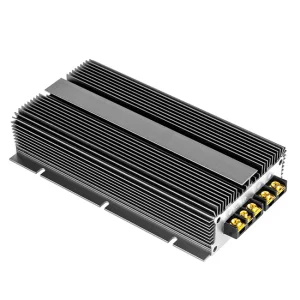
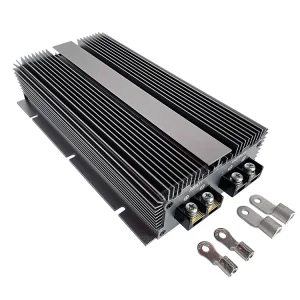
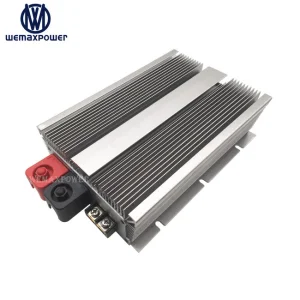
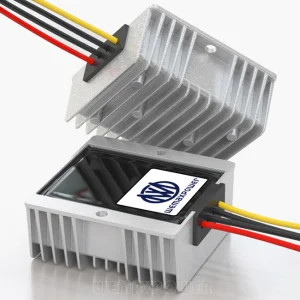
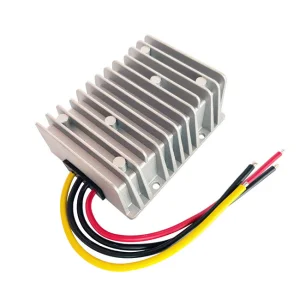
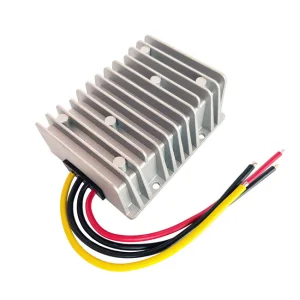
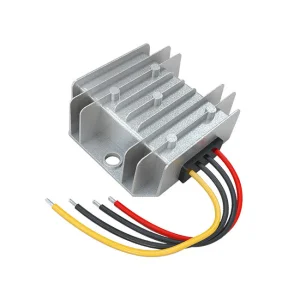
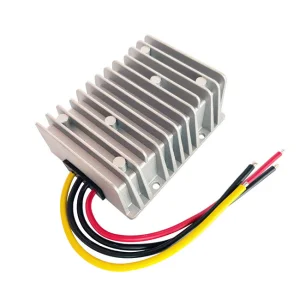
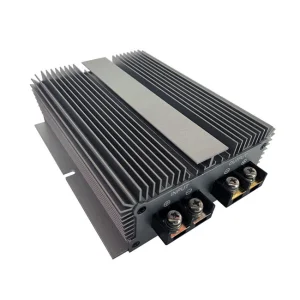
Step Down DC-DC Converter Manufacturers & Manufacturer

High-Efficiency Industrial Buck Regulators, Waterproof Power Conversion Modules, and OEM/ODM Engineering Solutions for Global Enterprise Procurement

1. Step-Down DC-DC Topologies: Design and Efficiency

Step-down DC-DC converters, also known as buck converters, are essential circuits for modern electrical engineering. They decrease a higher DC input voltage to a regulated, lower DC output voltage. Unlike linear regulators that waste excess energy as heat, synchronous buck topologies achieve high efficiencies (often exceeding 96%) by utilizing high-frequency MOSFET switches, inductors, and capacitors.

For industrial and transportation applications—ranging from forklift power distribution networks to communications arrays—minimizing conversion loss is critical. High-efficiency conversions reduce thermal management needs, extend battery runtime, and improve system reliability.

"An optimal buck converter design balances switching frequency, component footprint, and peak current limits. Selecting high-grade inductors with low DC resistance (DCR) and choosing MOSFETs with low gate charge (Qg) and RDS(on) are critical design choices."

Critical Technical Equations

In continuous conduction mode (CCM), the relationship between output voltage ($V_{out}$) and input voltage ($V_{in}$) is governed by the duty cycle ($D$):

D = V_out / V_in

The inductor value ($L$) required to limit the peak-to-peak ripple current ($\Delta I_L$) at a switching frequency ($f_s$) is calculated as:

L = (V_out * (V_in - V_out)) / (ΔI_L * f_s * V_in)

Shenzhen Wemaxpower Technology Co., Ltd.

Your Trusted Industrial Power Conversion Partner & Custom Manufacturer

Shenzhen Wemaxpower Technology Co., Ltd. is a leading manufacturer with over 7 years of specialized expertise in the power electronics sector. Our extensive product portfolio includes programmable DC power supplies, high-efficiency DC-DC converters, and industrial power modules.

We export to multiple global markets, serving clients across North America, Europe, Australia, and Asia. Our success relies on engineering innovation, responsive technical support, and strict quality control protocols.

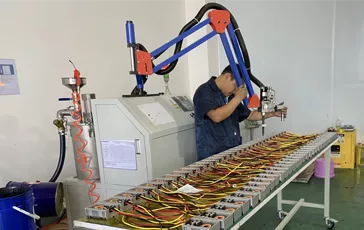
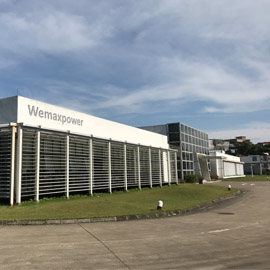
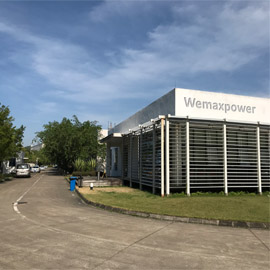
Our facility features advanced automated assembly lines, high-frequency transformer winding stations, SMT placement areas, and specialized environmental chambers for temperature-controlled aging tests.
01
Raw Material Inspection
Incoming QA testing of all critical active and passive components, including MOSFETs, magnetic cores, capacitors, and PCB substrates.
02
Semi-Finished Product Test
In-circuit testing (ICT) post-SMT assembly to verify soldering integrity, correct component placement, and electrical continuity.
03
Finished Product Test
Functional performance testing across all input-voltage thresholds, checking output regulation, ripple noise, and protective circuits.
04
Environmental Burn-in & Aging
100% full-load thermal chamber aging tests to eliminate infant mortality failures before shipment.

China's Manufacturing and Supply Chain Advantages

How Wemaxpower leverages the Shenzhen electronics ecosystem to deliver value, speed, and reliability.

Component Ecosystem Integration
Shenzhen houses the world's most concentrated ecosystem of passive component manufacturers, magnetic material suppliers, and semiconductor packaging plants. This regional network ensures rapid access to raw materials and shorter lead times.
Rapid Prototype Iteration
With direct engineering feedback loops, we can transition a custom voltage specification from initial design to fully validated physical prototypes in weeks, compared to months in other regions.
Cost-Effective Engineering
Scale efficiency and optimized manufacturing lines allow us to maintain high component quality standards (e.g., using brands like Murata, TI, and Nexperia) while remaining globally competitive.

Precision Tooling and Testing Equipment in our Factory
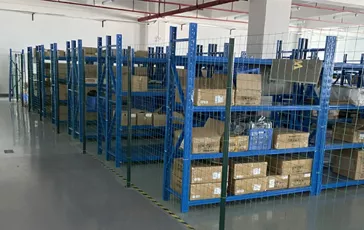
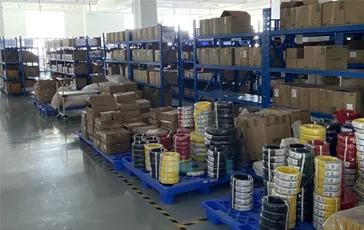
Wemaxpower wave soldering machine Wemaxpower automated optical inspection Wemaxpower warehouse and testing rack

Global Procurement Demands & Application Scenarios

How global buyers source step-down converters for key industrial applications.

Local Market Applications

  • Automotive & Transit: Converting 48V, 72V, or 80V down to stable 12V or 13.8V rails to power headlamps, control systems, and electronics in electric vehicles, buses, and golf carts.
  • Material Handling: Electric forklifts operate on large battery packs (48V to 96V). Step-down regulators convert this voltage to 24V or 12V to power control systems, hydraulic pumps, and onboard displays.
  • Marine Systems & RVs: House batteries require regulated conversion to operate safety equipment, lighting networks, and marine radios without electrical noise interference.
  • Telecom & Outdoor Stations: Outdoor environments expose equipment to moisture and temperature shifts, requiring IP67 waterproof and fully potted step-down converters.

Engineering & Sourcing Checklist

  • Static Regulation Accuracy: Does the output voltage drift under load changes? Our converters maintain precision within a ±1% range.
  • Thermal Performance: Does the design use aluminum shells with high thermal conductivity? We use custom extrusion cases and thermal potting to maximize convective heat transfer.
  • Safety Protections: Look for over-current protection (OCP), over-temperature protection (OTP), over-voltage protection (OVP), and output short-circuit recovery.
  • Certifications & Standards: CE, RoHS, and FCC compliance are necessary to meet regional electrical safety and environmental guidelines.

Industry Trends & Technical Reference Specifications

Explore the evolution of power electronics alongside our standard product selection guidelines.

>96%
Conversion Efficiency
Achieved via synchronous rectification and low-loss magnetics.
IP67
Ingress Protection
Fully potted with thermally conductive epoxy for harsh environments.
7+ Yrs
Industrial R&D
Proven reliability across global industrial installations.

Market Drivers and Trends

The power electronics industry is transitioning toward higher power density and wider bandgap semiconductors, such as Gallium Nitride (GaN) and Silicon Carbide (SiC). These materials enable higher switching frequencies, reducing the size of passive components like inductors and capacitors while improving thermal efficiency. Furthermore, modern fleets require smart, digitally controlled DC-DC converters that report diagnostics and power telemetry over communication buses like CAN-bus.

Typical Input Range Nominal Output Voltage Peak Output Current IP Rating Primary Industrial Applications
36V / 48V / 60V / 72V 12V DC 60A / 100A IP67 Waterproof Electric vehicles, golf carts, buses, material handling
48V to 80V 13.8V DC 80A / 100A IP67 Waterproof Radio stations, telecommunications, transit systems
24V DC 13.8V DC 3A / 100A Metal shell casing Automotive radio arrays, mobile communication terminals
12V / 24V 5V DC 5A / 40A IP67 Waterproof Bus USB charging docks, display units, low-power microcontrollers
60V / 72V 24V DC 10A IP67 Waterproof Forklift control networks, heavy machinery instrumentation

Technical FAQ - Step Down DC-DC Converters

In-depth engineering and procurement guidance for technical buyers.

Q1: What is the primary advantage of synchronous rectification in step-down converters?
In non-synchronous buck converters, a freewheeling diode handles energy discharge. The forward voltage drop of this diode (typically 0.4V to 0.7V) creates conduction losses under high currents. Synchronous rectification replaces this diode with a low-resistance MOSFET. Controlled to switch on during the off-state of the main switch, the MOSFET reduces the voltage drop and improves efficiency, especially in low-voltage, high-current applications like 12V output systems.
Q2: Why is IP67 waterproofing crucial for forklift and golf cart DC-DC step-down converters?
Forklifts, utility trucks, and golf carts operate in outdoor environments exposed to rain, humidity, washdown cycles, dust, and vibration. An IP67 rating ensures the internal components are sealed against dust ingress and water submersion up to 1 meter. This reliability is achieved through complete encapsulation using high-grade, thermally conductive potting compounds.
Q3: How does input voltage ripple affect buck regulator output stability, and how is it mitigated?
High input voltage ripple, caused by battery draw or generator switching, can cross the regulation boundary and appear at the output as noise. To prevent this, we integrate high-frequency ceramic capacitors with low Equivalent Series Resistance (ESR) alongside bulk electrolytic capacitors at the input. This helps smooth voltage transients, while feedback loops maintain steady regulation.
Q4: Can step-down DC-DC converters be connected in parallel to increase current capacity?
Standard step-down converters without active current-sharing control cannot be safely connected in parallel. Small differences in output voltage settings can cause one converter to supply the entire load, triggering overcurrent protection. For parallel operation, choose modules with built-in active current-sharing pins or drop-compensator circuitry.
Q5: How does Wemaxpower handle thermal management in a 100A high-power step-down module?
Our high-power modules use heavy-duty aluminum housings designed with optimal fin spacing to maximize convective cooling. Internally, power switches and magnetic components are mounted directly to the metal housing via high-thermal-conductivity materials. This maintains low component junction temperatures even during continuous high-load operations.
Q6: What certifications are standard for Wemaxpower step-down converters?
Our products meet global safety standards, including CE marking and RoHS compliance for the European market. We also design and test our products to comply with FCC requirements for radiated emissions, ensuring they do not interfere with nearby communication electronics.
All Step Down DC-DC Converter Products