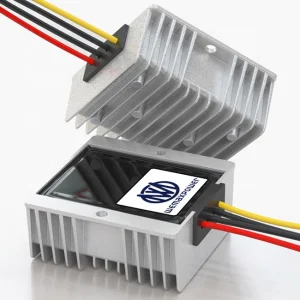
Explore our top-tier synchronous step up-down converters engineered for premium efficiency, featuring robust waterproof designs and exceptional thermal handling capabilities.
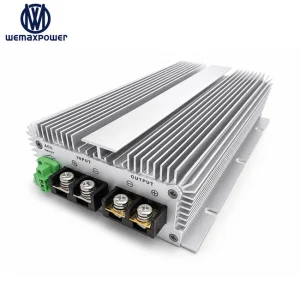
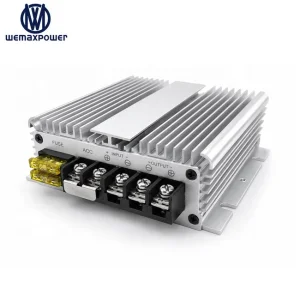
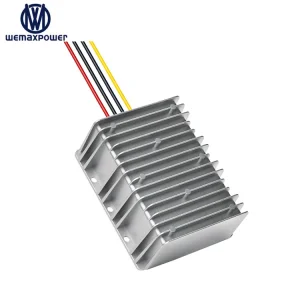
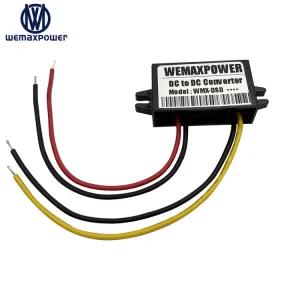
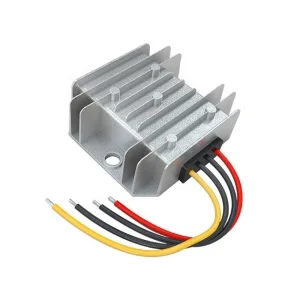
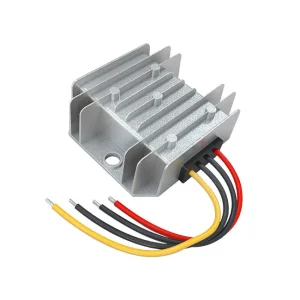
The global demand for high-reliability step up-down (buck-boost) DC-DC converters is experiencing exponential growth, driven by the rapid transformation of the electric vehicle (EV) sector, renewable energy systems, maritime electrification, and modern telecommunication grids. Unlike simple step-up (boost) or step-down (buck) topology modules, a step up-down converter is uniquely engineered to sustain a pre-defined target output voltage even when the input line voltage fluctuates significantly above or below that target value.
In industrial systems, battery-powered application fields, and vehicular infrastructures, battery terminal voltages vary substantially during different cycles (charging vs. discharging) and load conditions (high-current transient spikes from starting heavy machinery). For instance, a nominal 24V battery stack may charge at up to 29.4V and discharge down to 18V. To keep sensitive onboard audio, marine communication units, or industrial control modules running stably at a constant 24V or 13.8V, the integration of a rugged buck-boost converter is non-negotiable.
As a leading step up-down DC-DC converter exporter and manufacturer, Shenzhen Wemaxpower Technology Co., Ltd. supplies industrial markets with solutions that boast up to 96% efficiency, utilizing advanced synchronous rectification technology. These converters minimize thermal stress, extend system life cycles, and offer unmatched power-density profiles demanded by contemporary global OEMs.
Engineered to support heavy transients, protecting delicate radios, GPS systems, and sensors during engine ignition drops or alternator load-dumps.
Robust IP68 waterproof and dustproof structural housings paired with epoxy potting to defy salt, vibrations, and high moisture levels.
Wide input operational parameters ranging from 12V to 48V, establishing a reliable, noise-free local DC voltage environment for data components.
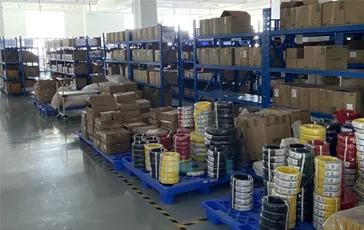
With over 7 years of specialized manufacturing experience, Shenzhen Wemaxpower Technology Co., Ltd. has established itself as an authoritative leader in programmable DC power supplies, step up-down DC-DC converters, and specialized power module designs. Our production unit is geared towards satisfying demanding industrial requirements worldwide, supporting sectors that cannot afford downtime.
Every single step up-down regulator we produce represents our dedication to robust engineering. We implement advanced safety features, including reverse-polarity protection, over-current cutoff, over-voltage clamping, and auto-recovery thermal shutdown systems. By optimizing our manufacturing loops and component sourcing, we supply global markets with premium products that perform reliably under complex, high-stress environments.
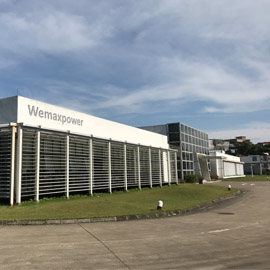
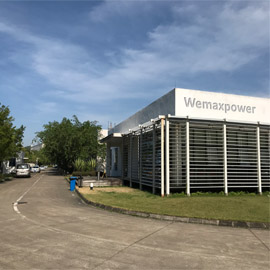

To maintain our status as a trusted exporter, Wemaxpower subjects all DC-DC step up-down regulators to a thorough 4-step quality assurance protocol, minimizing product failures on the field.
Incoming verification of MOSFETs, thick-copper PCBs, aluminum cases, and premium inductors to guarantee high-stress durability.
In-circuit parametric checking of the oscillator circuit, switching nodes, and thermal management channels before sealing.
Full operational spectrum testing under varying loads. Verification of the stabilization range (voltage ripple, efficiency).
Comprehensive thermal stress chamber testing under peak load to eliminate early-stage component failures before shipping.
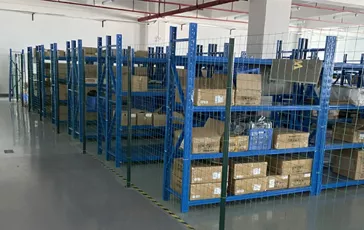
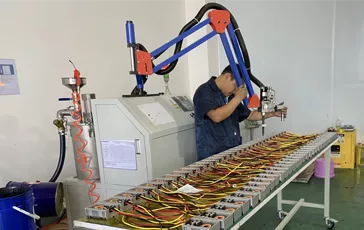
Our engineering team continuous to innovate, pushing boundary efficiencies and density structures. Here is our technological roadmap for the future.
Transitioning from traditional silicon MOSFETs to Gallium Nitride (GaN) and Silicon Carbide (SiC) semiconductors, dramatically slashing switching loss characteristics while enabling higher operational frequencies.
Integrating microcontrollers to support digital PWM loop adjustments, facilitating real-time monitoring and dynamically tunable output voltages over software configurations.
Utilizing high-performance ceramic capacitors (MLCC) and specialized thermally-conductive epoxy resins to handle high-vibration automotive and defense setups.
Buck-Boost technology resolves complex, real-world electrical distribution problems. Here is how our products stabilize operations in the field.
Automobile battery networks suffer from severe voltage variations. During engine start sequences, the starter motor draws massive currents, pulling the 12V battery down to 8V or 9V. Conversely, when the alternator runs, it outputs up to 14.4V. Such fluctuations induce noise in radio communication arrays, disrupt data logging computers on commercial buses, and cause high-fidelity audio systems to reset.
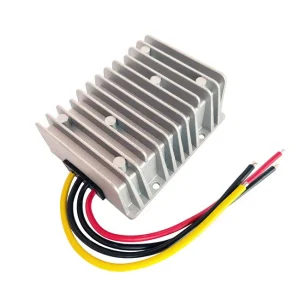
Our solutions, such as the With Fuse ACC Control 40amp Car Voltage Regulator, stabilize output at a steady 13.8V or 24V. They deliver continuous power regardless of starter-motor sag, providing clean and noise-free voltage for professional radio setups, passenger information displays, and emergency transceivers.
Offshore vessels rely on battery banks that must power heavy inductive loads like bilge pumps, thrusters, and anchor winches. The activation of these loads triggers instantaneous voltage drops across the vessel's electrical bus. Marine communication equipment and GPS plotters, however, require strict voltage compliance to avoid connection dropouts.
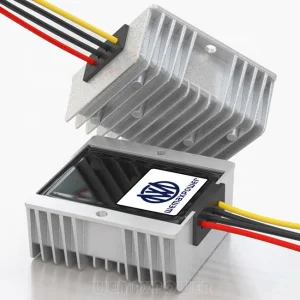
Our Waterproof IP68 Step Up-Down Converters are designed to bridge this gap. By utilizing waterproof enclosures, they withstand salt-laden humidity and water spray, delivering steady DC voltage under severe environmental conditions.
Telecom installations often route DC power over long cables, inducing resistive voltage drops. A nominal 48V distribution network may measure significantly lower at remote end-points. To stabilize local operations at 24V, a simple buck regulator is insufficient if the line voltage drops below the threshold.
Our buck-boost modules resolve this by automatically transitioning between step-up and step-down states based on the real-time line level, maintaining stable voltages over wide input ranges.
Solar arrays and lithium battery storage systems experience state-of-charge (SoC) fluctuations from peak-charge values down to deep discharge zones. Implementing a reliable, high-power buck-boost DC-DC converter ensures industrial robotics, PLCs, and control systems receive stabilized power as the battery discharges, maximizing battery capacity utilization.
Find expert answers to common queries regarding step up-down voltage regulators, buck-boost topologies, and deployment best practices.
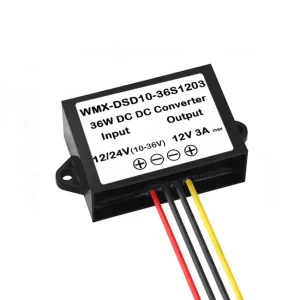
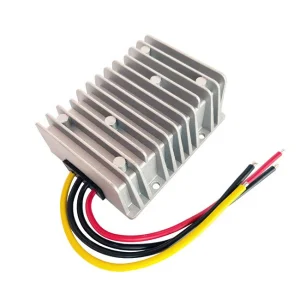
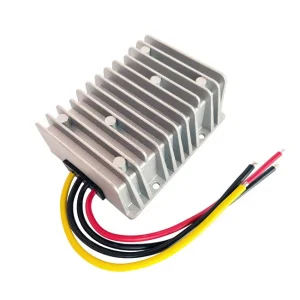
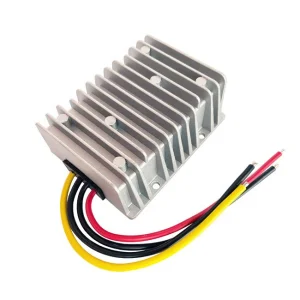
High-power buck-boost models and heavy-duty automotive stabilizers built to supply clean, regulated DC voltage to demanding loads.
 Wemax Power