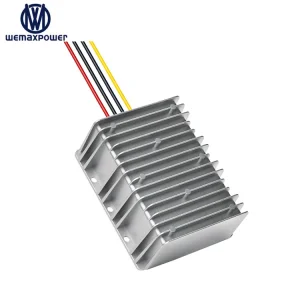
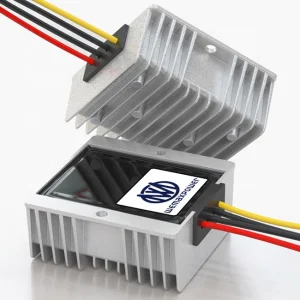
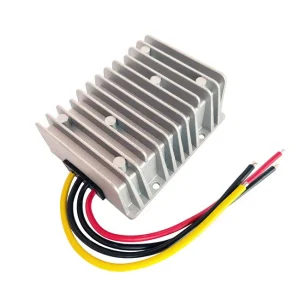
Our premium flagship converters engineered specifically for volatile transit networks and heavy industrial grids across the British Isles.
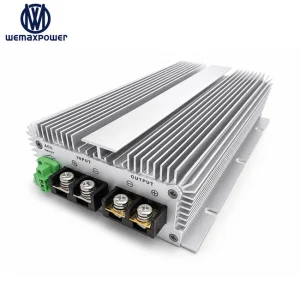
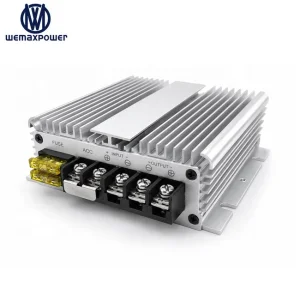
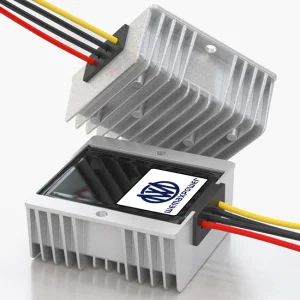
The United Kingdom's commitment to achieving Net-Zero carbon emissions by 2050 has triggered a major paradigm shift in industrial electrification, smart transportation networks, and green infrastructure. This transition relies heavily on stable, high-efficiency DC-DC power conversion technologies. Industrial sites, electric vehicle (EV) charging stations, wind farms, and maritime transport fleets face complex power environments where voltage inputs fluctuate widely due to load demands, battery decay, and grid instabilities.
In this dynamic landscape, standard step-down (buck) or step-up (boost) converters are often insufficient. Power systems require non-isolated Buck-Boost (Step Up-Down) converters that seamlessly transition between boosting and bucking modes. This ensures a stable output voltage (e.g., 12V, 13.8V, 24V, or 48V) even when the input battery pack drops below or rises above the target output level. This flexibility is essential for maintaining operational continuity in harsh environments.
Wemaxpower's DC-DC step up-down converters employ advanced 4-switch synchronous rectification topologies. Traditional converters rely on diode rectifiers, which suffer from high forward voltage drops and subsequent thermal energy loss. Our synchronous design replaces diodes with high-frequency MOSFETs. This configuration reduces conduction losses and pushes power conversion efficiency up to 96%.
Crucially for the UK market, our designs incorporate active EMI filtering and soft-switching algorithms. This ensures minimal electromagnetic interference (EMI), satisfying strict BS EN standards. The ability to handle wide input variations—such as a battery discharge curve ranging from 8V to 40V—while maintaining a rock-solid 13.8V or 24V output makes these modules indispensable for critical military, aerospace, and communication applications across England, Scotland, Wales, and Northern Ireland.
Designed for deployment in demanding environments, from North Sea wind platforms to London heavy transit systems.
Achieves up to 96% efficiency by substituting Schottky diodes with low Rds(on) MOSFETs, minimizing energy loss and heat generation inside closed control cabinets.
Integrated transient voltage suppression (TVS) protects sensitive loads from input spikes, alternator load dumps, and electrical noise typical in heavy machinery.
Encapsulated in thermally conductive epoxy resin with a die-cast aluminum housing. Excellent natural convection cooling handles ambient temperatures from -40°C to +85°C.
Optimized for 13.8V rail/road vehicle radio telematics and marine electronics operating under unstable battery charging cycles.
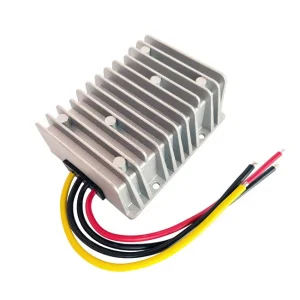
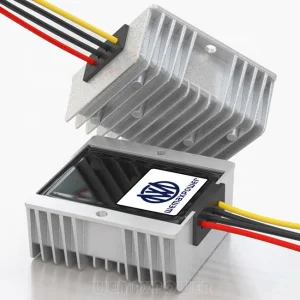
For procurement officers and R&D engineers in the UK, sourcing power electronics involves navigating logistics, custom requirements, and supply chain constraints. Standard off-the-shelf power converters often fall short when integrations require specific dimensions, unique input-output voltage ratios, or specialized wiring harnesses.
At Wemaxpower, we specialize in OEM/ODM design customization. Whether you require integrated ACC control for transport fleet ignition tracking, custom-placed fuse protection, or specific IP ratings, our engineering team can modify electrical characteristics and physical layouts to fit your system envelope. By partnering with international freight forwarders, we ensure direct-to-destination delivery to UK industrial hubs like Birmingham, Manchester, Leeds, and Glasgow, offering customized customs clearance and DDP options.
Following the UK's transition out of the European Union, electrical and electronics products sold in Great Britain must comply with the UKCA (UK Conformity Assessed) regulations. Standard CE markings alone are no longer sufficient for complete domestic compliance. Our manufacturing facility has updated its testing regimens to align with these guidelines.
Our converters undergo rigorous certification testing to conform to BS EN standards, including BS EN 62368-1 (safety for audio, video, information, and communication technology equipment) and BS EN 50155 (railway applications electronic equipment). These certifications ensure that when you integrate a Wemaxpower DC-DC buck-boost converter into your end product, it meets the statutory compliance criteria for sale within England, Scotland, and Wales.
Reliability is designed in and verified through testing. Every module undergoes four strict testing phases before shipment.
With over 7 years of specialized manufacturing experience, Shenzhen Wemaxpower Technology Co., Ltd. has established a reputation for manufacturing programmable DC power supplies, high-efficiency DC-DC converters, and robust power modules. Our manufacturing operations run on a zero-defect quality management system structured around four critical verification steps:



Future-proofing UK electronics infrastructure through investments in advanced semiconductor materials and smart topologies.
The future of power electronics lies in Wide Bandgap (WBG) materials like Gallium Nitride (GaN) and Silicon Carbide (SiC). Standard silicon-based converters are limited in switching speed and thermal efficiency. By transitioning our R&D designs toward GaN and SiC topologies, Wemaxpower is developing step up-down converters with significantly reduced footprints, higher power densities, and lower thermal profiles.
For UK system integrators, this transition means more power packed into smaller, lighter enclosures. This is a critical factor for lightweight electric aircraft, unmanned aerial vehicles (UAVs), and crowded EV engine bays. Furthermore, we are developing smart monitoring interfaces, such as CAN bus and PMBus protocols, allowing real-time monitoring of input voltages, output loads, and temperatures directly from a central control unit.
| Parameters | Standard Silicon Class | Next-Gen GaN / SiC Class |
|---|---|---|
| Switching Frequency | 100 kHz - 250 kHz | 500 kHz - 1.5 MHz |
| Max Efficiency | 92% - 94% | 96% - 98.5% |
| Power Density | Standard Base | Up to 3x higher |
| Heat Generation | Moderate-High | Ultra-low |
| Enclosure Dimensions | Standard Aluminum | Compact / Miniaturized |
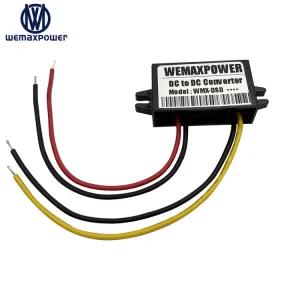
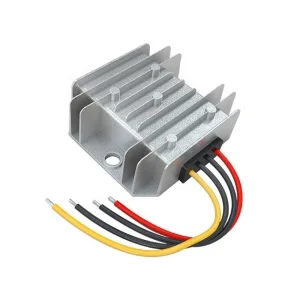
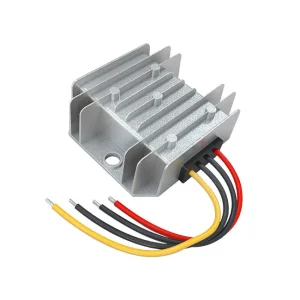
Browse our selection of IP67 waterproof converters and heavy-duty automotive stabilizers optimized for UK commercial and industrial applications.
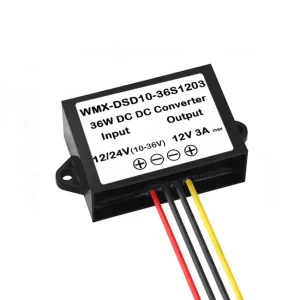
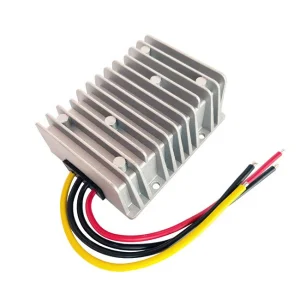
Technical and logistical insights to assist UK system designers and procurement leads.
Technically, they describe the same functionality: the ability to handle an input voltage that may be higher, lower, or equal to the desired output voltage. In the industry, "buck-boost" refers to the circuit topology (e.g., 4-switch synchronous buck-boost), while "step up-down" describes the system-level function to the user.
Wemaxpower conducts a strict 4-step quality control (QC) process: Raw Material Inspection (IQC), In-Circuit Semi-Finished Board Testing (IPQC), Finished Parameter Auditing (FQC), and a high-temperature full-load aging burn-in test (OQC) for 100% of our products before they leave the factory floor.
Yes. All of our direct-exported models are manufactured to meet UKCA compliance rules. We test against European and British Harmonized standards (including BS EN 62368-1, EN 55032 for electromagnetic compatibility, and EN 50155 for rail-specific requirements) to ensure trouble-free integration and certification within local UK markets.
Absolutely. We offer comprehensive OEM/ODM customization services. We can configure specific output voltages (e.g., 13.8V for radio gear, 24V or 36V for heavy industrial setups), design custom current limiting profiles, add remote control logic (like ignition sensing/ACC controls), and modify the enclosure or wiring terminal connections.
For standard catalog items, production and preparation take between 7 to 15 working days. Air freight delivery via DHL/FedEx directly to UK business hubs takes 3 to 5 business days, while bulk sea freight orders take 30 to 35 days, depending on port-of-entry logistics.
 Wemax Power