Wemax Power


Technical Deep Dive: The Critical Role of Single Output Power Supplies in Modern Systems
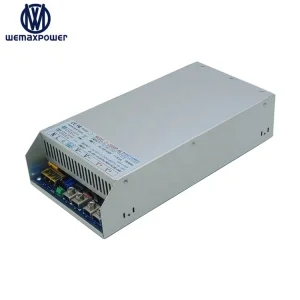
In high-stakes industrial, telecom, and transportation ecosystems, electrical noise and line fluctuation are constant threats to structural integrity and system performance. The decision to use a single output power supply architecture rather than multi-channel solutions is driven by a fundamental engineering truth: the need for absolute galvanic isolation, highly stable line regulation, and zero cross-regulation error.
Unlike multi-output systems, which share a single feedback loop and suffer from cross-regulation limitations (where a dynamic load variation on one channel compromises the voltage precision of another), a dedicated single output topology ensures that all magnetic components, filtering capacitors, and control loops focus on a single target load. This isolation eliminates feedback cross-talk, ensuring critical machinery, microcontrollers, and communication hubs function without glitching.
Why Procurement Executives Prioritize Industrial-Grade Architecture
When sourcing power modules for long-lifecycle programs, corporate buyers are not simply purchasing hardware; they are securing reliability. Critical failure modes in low-quality converters—such as high ripple voltage, poor thermal dissipation, and transformer saturation—can cause catastrophic downtime. High-reliability suppliers prevent these issues through robust engineering, utilizing high-temperature automotive-grade potting compounds, oversized magnetic cores, and high-frequency LLC resonant switching topologies that minimize stress on semiconductor switches.
Overcoming Grid & Alternator Fluctuation with Buck-Boost Topologies
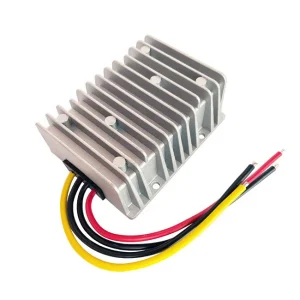
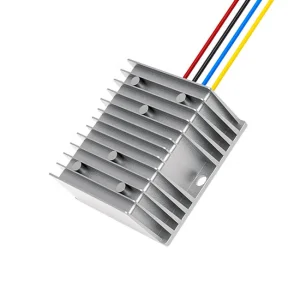
In vehicular, marine, and heavy equipment environments, the source voltage is inherently unstable. Standard lead-acid or LiFePO4 battery banks experience massive voltage sags during starter-motor activation, and alternators produce significant voltage spikes. High-efficiency buck-boost converters bridge this gap. By utilizing four-switch synchronous rectification, these components transition seamlessly between step-up and step-down modes, delivering a steady, regulated output even as the input voltage swings wildy above and below the target value.